

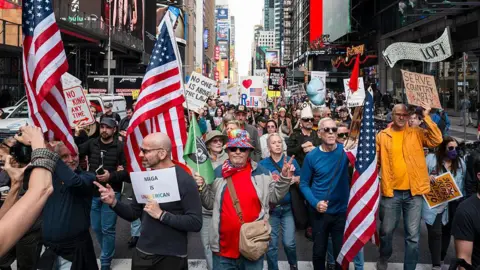
The recent 'No Kings' demonstrations drew an estimated mass gathering across the United States to oppose President Donald Trump's policies and his inclination to push the boundaries of White House control.
This represented a moment for like-thinking liberal voters, progressive individuals and certain Republican dissenters to rally together at a time when the American left has minimal governmental control in national politics.
But what direction should they take from here?
Record Attendance Surpasses Projections
Based on observations, the turnout at the recent events - in large American urban centers like the Windy City, NYC, Washington and Los Angeles, as well as countless rural areas – was greater than projected and outdid the first anti-monarchy demonstration in June.
GOP lawmakers had warned that the demonstrations would be against national interests, and some right-leaning executives had placed their police forces and military reserves on readiness in instance of violence.
The massive demonstrations proved to be peaceful – a festival, not carnage. In NYC, there were not any demonstration-linked arrests, and the assembly in Washington DC included parents and children and youths.
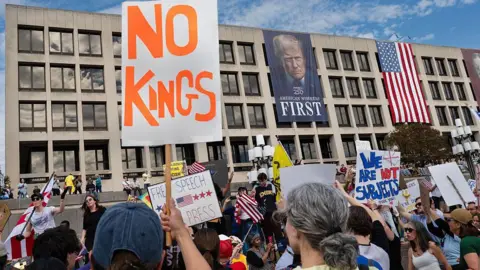
"Today throughout the United States in figures that could surpass any day of demonstration in our nation's history, the people are declaring clearly and confidently that we are a liberty-loving nation, we are not to be a society that can be controlled, our administration is not purchasable," a prominent senator declared in his remarks to the Washington DC demonstration.
Administration Response and Governmental Implications
Just down the street from the 'No Kings' gathering in the nation's capital, the White House answered the rallies with disdain.
"Who cares," an administration spokesperson wrote in response to multiple media inquiries about the protests.
the commander-in-chief shared various AI-generated videos on his online network of him displaying a crown, showing a particular instance where he was piloting a aircraft that dumped what seemed to be human waste on the demonstrators.
Even though conservative lawmakers may be minimizing the impact of the marches, the magnitude of the participation – coupled with the president's net negative public support in major research studies - indicates a liberal opportunity to rebound from recent election losses.
The Democratic Party's Obstacles and Party Divisions
The Democratic organization still has a long way to go to regain power, however.
Research show only a third of Americans view it favorably - the lowest for a generation - and Democratic leaders are divided over methods to mount an effective challenge to the administration when they lack both houses of Congress.
Left-leaning individuals marched on recently for a diverse motivations. The administration's aggressive immigration enforcement, his trade measures, his spending reductions, his global strategy, his use of military reserves in US cities and his precedent-challenging use of executive power were all frequent subjects of concern and indignation.
A portion of the dissatisfaction was additionally aimed at liberal officials.
"We are simply accepting defeat, and we're remaining silent," a particular march attendee in the capital told media outlets on Saturday. "You know, I feel we must throw some more elbows. Unfortunately, the high road fails to produce results."
Budget Impasse Tactic and Political Dangers
Liberal legislators have been increasingly confrontational over the ongoing budget impasse, which is about to enter its month-long duration. They have been unwilling to authorize a short-term continuation of present national budget without a cross-party deal to address healthcare assistance for financially struggling individuals set to expire at the year's close.
Due to congressional protocols, liberal lawmakers have certain influence even though being in the minority – and, to date, the general population seems to be attributing comparable responsibility for the impasse to the president and the Republican majority.
However the tactic carries dangers too. The pain from the closure – notably for members of the progressive alliance – is only going to increase as the weeks pass.
Numerous public servants have been denied wages and are facing financial hardship. Monetary resources is expected to run out for low-income food support. The federal courts is cutting back its functions. And the executive branch is using the impasse to order additional reductions to the federal workforce and freeze national expenditures, targeting Democratic states and urban centers.
Forthcoming Votes and Partisan Outlook
The truth is that liberal officials in the upper chamber will finally have to identify a resolution of the situation. But they may be hard-pressed to achieve agreements that the protesters who marched on recently will approve of.
"If|In case|


